
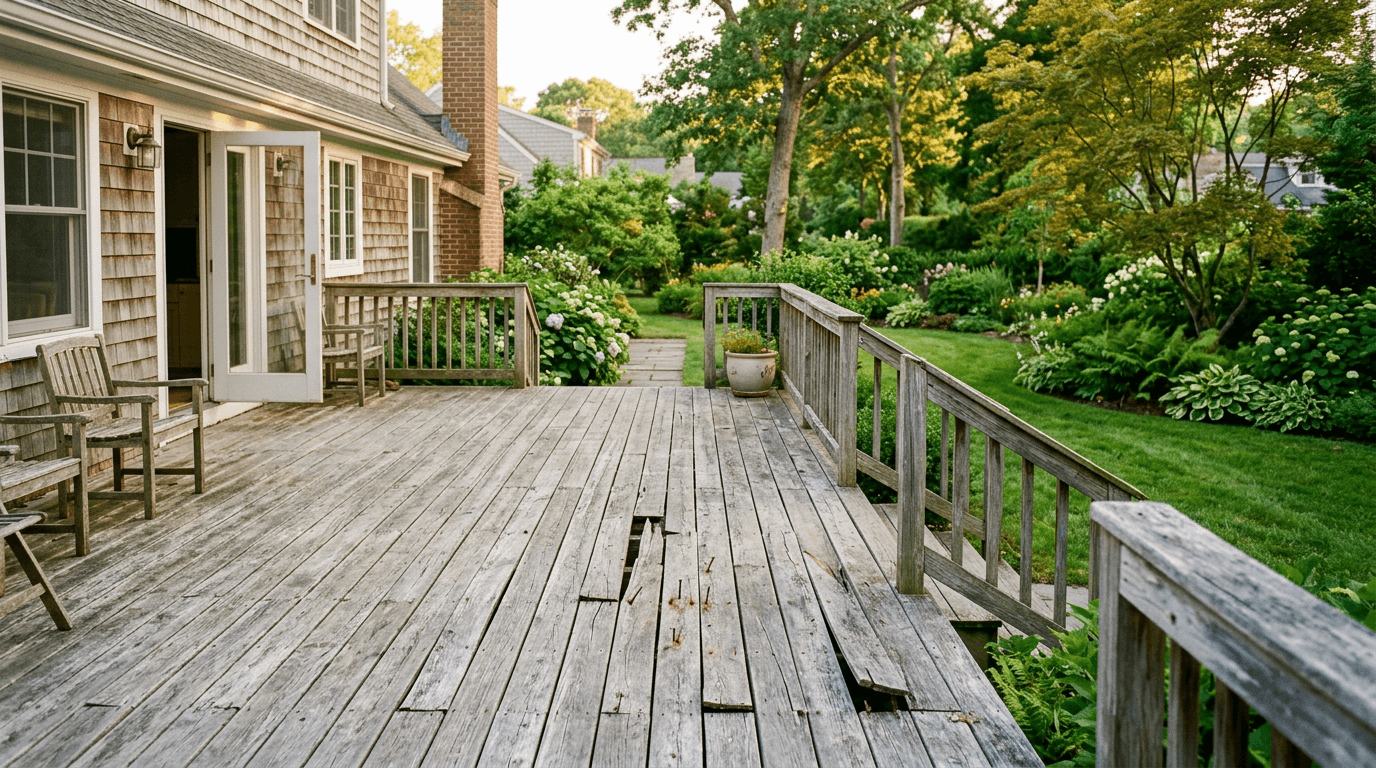
Decks take a beating from Rockland County weather — hot humid summers, freezing winters, and everything in between. Here are the warning signs that yours needs attention.
**Soft or Spongy Boards**
The biggest red flag. If a board feels soft or gives more than it should, the wood is rotting from within. Poke suspect areas with a screwdriver — if it sinks in easily, that board needs replacing. Rot spreads to adjacent boards and structural components, so do not wait.
**Loose or Popping Nails and Screws**
Repeated expansion and contraction works fasteners loose over time. Popping nails are a tripping hazard and a sign that boards are moving too much. Old nails can often be replaced with deck screws for a more secure connection.
**Wobbly Railings and Posts**
Give your railings a firm shake. Significant movement means weakened connections. Railings are a critical safety feature, especially on elevated decks. Repair immediately.
**Cracked or Splintering Boards**
Surface cracks are normal with natural wood. Deep splits through the board or extensive splintering across multiple boards indicate the wood is reaching end of life — and a barefoot hazard.
**Ledger Board Concerns**
The ledger board is where your deck attaches to your house — the most critical connection point and the number one cause of deck collapses when it fails. Look for gaps between the ledger and siding, water damage along this joint, or any visible deterioration.
**Mold, Mildew, and Discoloration**
Surface mold is normal in our climate and can be cleaned. Persistent mold on the underside of boards or structural members suggests trapped moisture that accelerates rot.
**Water Pooling**
Your deck should drain after rain. Pooling water means warped boards or a shifted structure. Standing water accelerates deterioration and creates slippery spots.
**Age and Maintenance History**
Pressure-treated decks last twenty to twenty-five years. Cedar and redwood last fifteen to twenty. If your deck is aging and has not been regularly sealed or stained, get it inspected.
**What to Do**
Many issues can be repaired without replacing the entire structure. At Odds & Ends, we inspect the full deck before recommending repairs — sometimes a few boards and new hardware are all it takes. Contact us for a free estimate.